
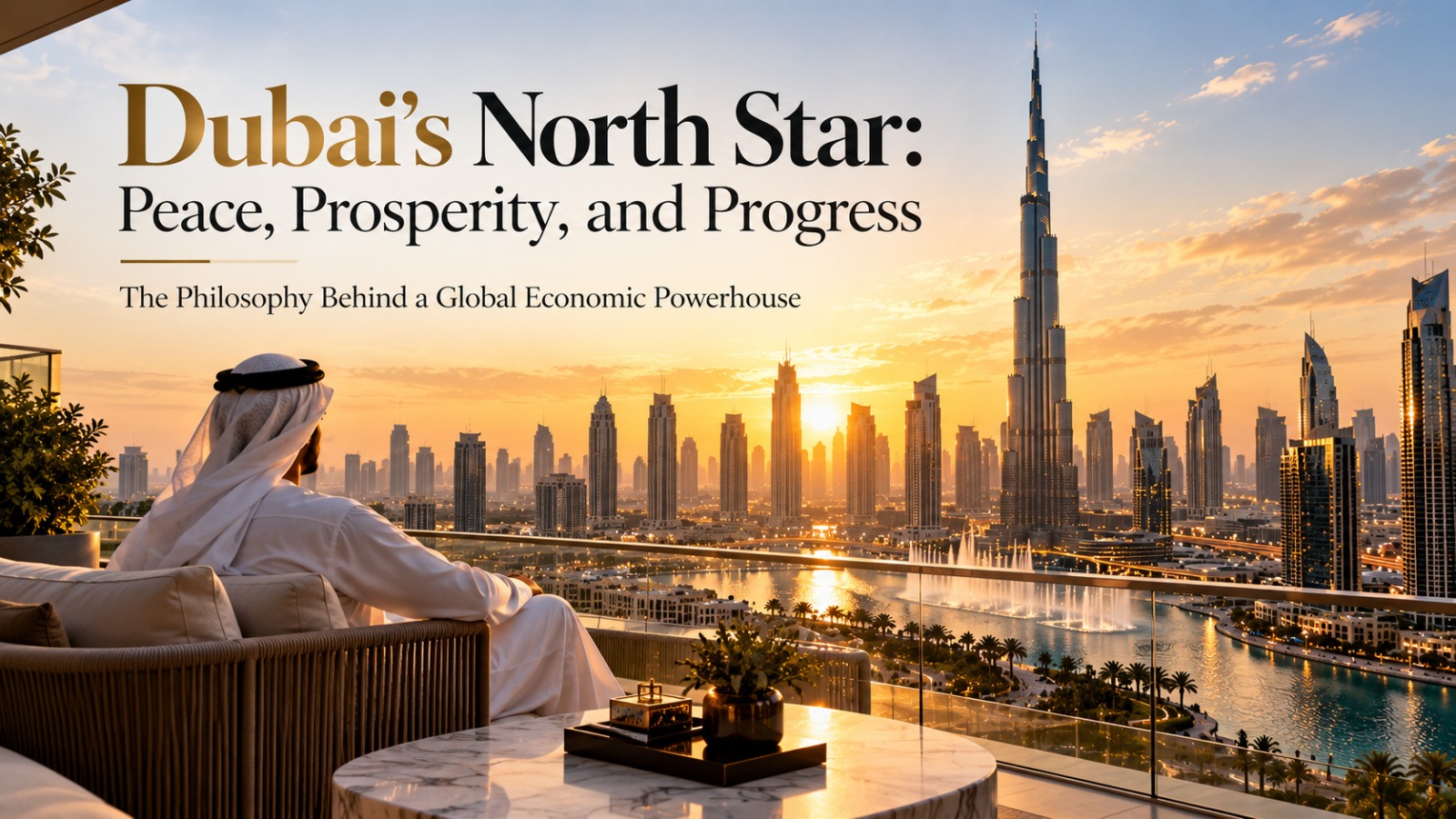
By Nasir Mahmood Siddiqui
Introduction: The Vision Behind Dubai’s Rise
Dubai’s transformation is one of the most remarkable economic stories of the modern world.
What was once a small trading and pearling community has developed into a global centre for business, finance, tourism, real estate, logistics, aviation and innovation. Behind this transformation is a simple but powerful idea: peace creates stability, stability creates prosperity, and prosperity creates the confidence to keep moving forward.
For Dubai, these three ideas peace, prosperity and progress are closely connected.
They can be seen in the way Dubai welcomes people from around the world, develops infrastructure before demand reaches its peak, encourages international investment and continuously looks for new areas of economic growth.
For investors, entrepreneurs and families, understanding this philosophy helps explain why Dubai has become much more than a regional business centre. It has become a global destination for capital, talent and opportunity.
Peace: The Foundation of Economic Confidence
No economy can grow sustainably without stability.
Dubai has built much of its international reputation around being a safe, predictable and welcoming place to live, work and invest. Its position between East and West has also allowed it to become a meeting point for different cultures, businesses and financial markets.
The Eight Principles of Dubai place considerable emphasis on openness, governance, justice and maintaining the conditions necessary for economic competitiveness.
One of the most important principles is the idea that no one is above the law. For international investors, this matters enormously.
When people invest in property, establish a company or move their family to another country, they want confidence that agreements will be respected, regulations will be clear and disputes can be addressed through established legal channels.
Dubai’s diverse population is another reflection of its global character. People from more than 200 nationalities live and work in the emirate, creating an environment where international business has become part of everyday life.
This diversity is not simply a demographic statistic. It is an economic advantage.
A businessman from India, an investor from Europe, a technology entrepreneur from Singapore, a family office from the Middle East and a property investor from Pakistan can all use Dubai as a common platform for international business.
That is one of the reasons stability has become one of Dubai’s most valuable economic assets.
Prosperity: Building an Economy Beyond Oil
Dubai’s economic story cannot be understood simply through oil.
The emirate has spent decades building an increasingly diversified economy based on trade, tourism, aviation, logistics, real estate, finance, technology, manufacturing and professional services.
This diversification has helped Dubai reduce its dependence on any single economic sector and create opportunities across a much broader business ecosystem.
Dubai’s GDP reached approximately AED 937 billion in 2025, with the economy recording strong annual growth. At the same time, the emirate’s non-oil foreign trade exceeded AED 3 trillion.
These numbers tell an important story.
Dubai is not simply growing because of one industry. It is building an ecosystem in which different industries support one another.
A logistics company creates demand for warehouses.
A growing technology company needs offices and housing for its employees.
International tourism supports hotels, restaurants, retail and transportation.
New businesses bring employees, which increases demand for residential property.
Population growth supports retail, schools, healthcare and community infrastructure.
This interconnected economy is particularly important for real estate investors because property demand is ultimately influenced by economic activity, employment, population growth and business formation.
In other words, real estate does not operate in isolation. It is part of the wider economic engine.
Dubai’s Attraction for Global Investors
Dubai has also strengthened its position as a destination for foreign direct investment.
The emirate has ranked among the world’s leading destinations for greenfield foreign direct investment projects, reflecting continued international confidence in its business environment.
For investors, the attraction is broader than tax considerations or property prices.
Dubai offers connectivity.
It offers access to international markets.
It offers a sophisticated financial and business-services ecosystem.
It offers modern infrastructure.
And, importantly, it offers an environment where international businesses can establish a regional base and reach customers across the Middle East, Africa, Asia and beyond.
This combination has helped Dubai develop into a global business platform rather than simply a local economy.
Progress: Putting People at the Centre
Economic growth alone does not define progress.
A successful city also needs to provide its residents with good infrastructure, efficient public services, safety, mobility and opportunities for the future.
Dubai’s development model increasingly focuses on these areas.
The city has invested heavily in roads, metro systems, airports, ports, digital infrastructure, healthcare, education and smart-city technologies.
The underlying objective is straightforward: make Dubai easier, safer and more efficient for people and businesses.
The Dubai Economic Agenda D33, launched in 2023, reflects this long-term approach. Among its ambitions is to double the size of Dubai’s economy by 2033 while strengthening the emirate’s position as a global centre for trade, investment and innovation.
For residents and investors, these ambitions have practical consequences.
Infrastructure influences where businesses locate.
Business growth influences employment.
Employment influences population growth.
Population growth creates demand for homes, schools, healthcare, retail and leisure.
And all of these factors influence the real estate market.
That is why Dubai’s infrastructure plans are closely watched by property investors.
Infrastructure: Building for the Dubai of Tomorrow
One of Dubai’s defining characteristics is its willingness to plan for the future.
The city has repeatedly invested in infrastructure before the full scale of future demand becomes obvious.
Major transportation projects, airport expansion, metro development and logistics infrastructure are designed to support Dubai’s continued growth as a global city.
The planned expansion of Al Maktoum International Airport, for example, represents a long-term investment in Dubai’s position as a global aviation and logistics hub.
Likewise, future metro and transport infrastructure can influence the development potential of surrounding communities.
For real estate investors, infrastructure is therefore more than a transportation issue.
It can change accessibility.
It can influence business locations.
It can support population growth.
And over time, it can reshape the property landscape.
Where Peace, Prosperity and Progress Meet
The real strength of Dubai is not any one of these three principles.
It is the relationship between them.
Peace creates confidence.
Confidence encourages investment.
Investment creates economic activity.
Economic activity creates prosperity.
Prosperity gives the government and private sector the resources to invest in infrastructure and innovation.
And that investment creates the foundation for further progress.
Dubai’s international events industry is a good example.
The Dubai World Trade Centre’s major events have become important contributors to the wider economy, bringing millions of visitors, business leaders and professionals into the emirate.
These events generate direct spending through hotels, restaurants, transportation and retail. But the longer-term impact can be even greater.
Business meetings create partnerships.
Partnerships create investment.
Investment creates companies.
Companies create jobs.
And jobs attract people.
This is how a modern global economic ecosystem develops.
Resilience: The Real Test of a Global City
The true strength of any city is not measured only during good times.
It is tested during difficult periods.
Dubai operates in a region that has experienced geopolitical uncertainty and economic shocks over the years. Yet the emirate has continued to position itself as a stable international centre for business and investment.
The events of 2026 have once again highlighted the importance of resilience.
Regional tensions created concerns for tourism, aviation, business confidence and international investment. Such circumstances test the credibility of any global city.
Dubai’s response demonstrated the importance of communication, institutional coordination and maintaining confidence among businesses and investors.
For an international investor, this is an important lesson.
A safe-haven destination is not one that is never exposed to external risks. No major global city can make that promise.
A stronger definition of resilience is the ability to respond quickly, maintain essential services, communicate clearly and continue building for the future.
That is an important part of Dubai’s economic story.
What Dubai’s Philosophy Means for Real Estate Investors
For property investors, the broader economic philosophy matters just as much as the property itself.
A building may offer an attractive yield, but the long-term performance of real estate depends on the environment surrounding it.
Is the population growing?
Are businesses expanding?
Is infrastructure improving?
Are regulations becoming clearer?
Is international investment increasing?
Are new employment centres emerging?
Are people choosing to live and work in the area?
These are the questions that should be considered alongside purchase price and rental yield.
Dubai’s initiatives in areas such as the Golden Visa, Smart Rental Index, digital transformation and property tokenisation demonstrate how the real estate sector is evolving alongside the wider economy.
The objective is not simply to sell more property.
It is to create a more transparent, efficient and internationally accessible real estate ecosystem.
For investors, this creates both opportunities and responsibilities.
The opportunities are significant, but so is the need for proper research and due diligence.
The Future: From Property Market to Global Asset Ecosystem
Dubai’s next phase may be even more interesting than its previous one.
The emirate is moving beyond the traditional concept of being simply a property market.
It is becoming an integrated ecosystem connecting real estate, finance, technology, logistics, tourism, artificial intelligence, digital assets and global investment.
Property will remain an important part of this ecosystem, but the way investors access, finance, manage and eventually trade real estate is likely to continue changing.
Technology will play an increasingly important role.
Artificial intelligence can improve market analysis and property management.
Blockchain can support new forms of ownership and transaction structures.
Digital platforms can make international investment more accessible.
Data can help investors make better decisions about location, pricing, rental demand and future development.
The result could be a real estate market that is increasingly connected to the broader global financial system.
The Bigger Picture
Dubai’s success is not the result of one landmark project, one economic sector or one generation of development.
It is the result of a long-term mindset.
The emirate has consistently focused on creating an environment where people can build businesses, families can establish their lives, investors can deploy capital and international companies can access regional markets.
That journey is far from complete.
Dubai will face challenges.
Real estate cycles will continue.
Global interest rates will change.
Geopolitical conditions will evolve.
Technology will disrupt existing industries.
Competition from other global cities will increase.
But Dubai’s greatest advantage may be its willingness to adapt.
The philosophy of peace, prosperity and progress provides a useful framework for understanding that adaptability.
Peace creates the confidence to invest.
Prosperity creates the resources to expand.
Progress creates the infrastructure and innovation needed for the next generation.
Together, these forces explain why Dubai continues to attract people and capital from around the world.
Conclusion: Dubai’s North Star
Dubai’s story is ultimately a story about confidence.
Confidence that businesses can grow.
Confidence that people can build their futures.
Confidence that infrastructure will continue to improve.
Confidence that the economy can diversify.
And confidence that the city will continue adapting to a changing world.
For investors, this perspective is important.
Real estate should never be viewed only as bricks, land and buildings. Property is part of a much larger economic system shaped by population, employment, infrastructure, regulation, technology and international capital.
Dubai’s peace, prosperity and progress provide the foundation of that system.
The next chapter of Dubai’s story will be written not only through new buildings and developments, but through innovation, investment, connectivity and the continued ability to create opportunities for people from around the world.
That is perhaps Dubai’s greatest strength — not simply where the city stands today, but its determination to keep building for tomorrow.
Key Takeaways
Peace creates confidence: Stability, safety and a predictable business environment are fundamental to Dubai’s international appeal.
– Prosperity comes through diversification: Dubai has built a broad economy spanning trade, tourism, aviation, logistics, finance, technology and real estate.
– Progress is people-focused: Infrastructure, smart-city initiatives and public services remain central to Dubai’s development strategy.
– Resilience matters: Dubai’s ability to respond to external challenges is an important part of its attractiveness as a global business and investment hub.
– Real estate is connected to the wider economy: Population growth, employment, infrastructure and foreign investment all influence property demand.
– The next phase will be technology-driven: AI, digital platforms, blockchain and tokenisation are likely to influence how real estate is owned, managed and invested in.
– Dubai’s long-term opportunity is broader than property: The emirate is developing into an integrated global ecosystem for capital, businesses, technology and talent.