
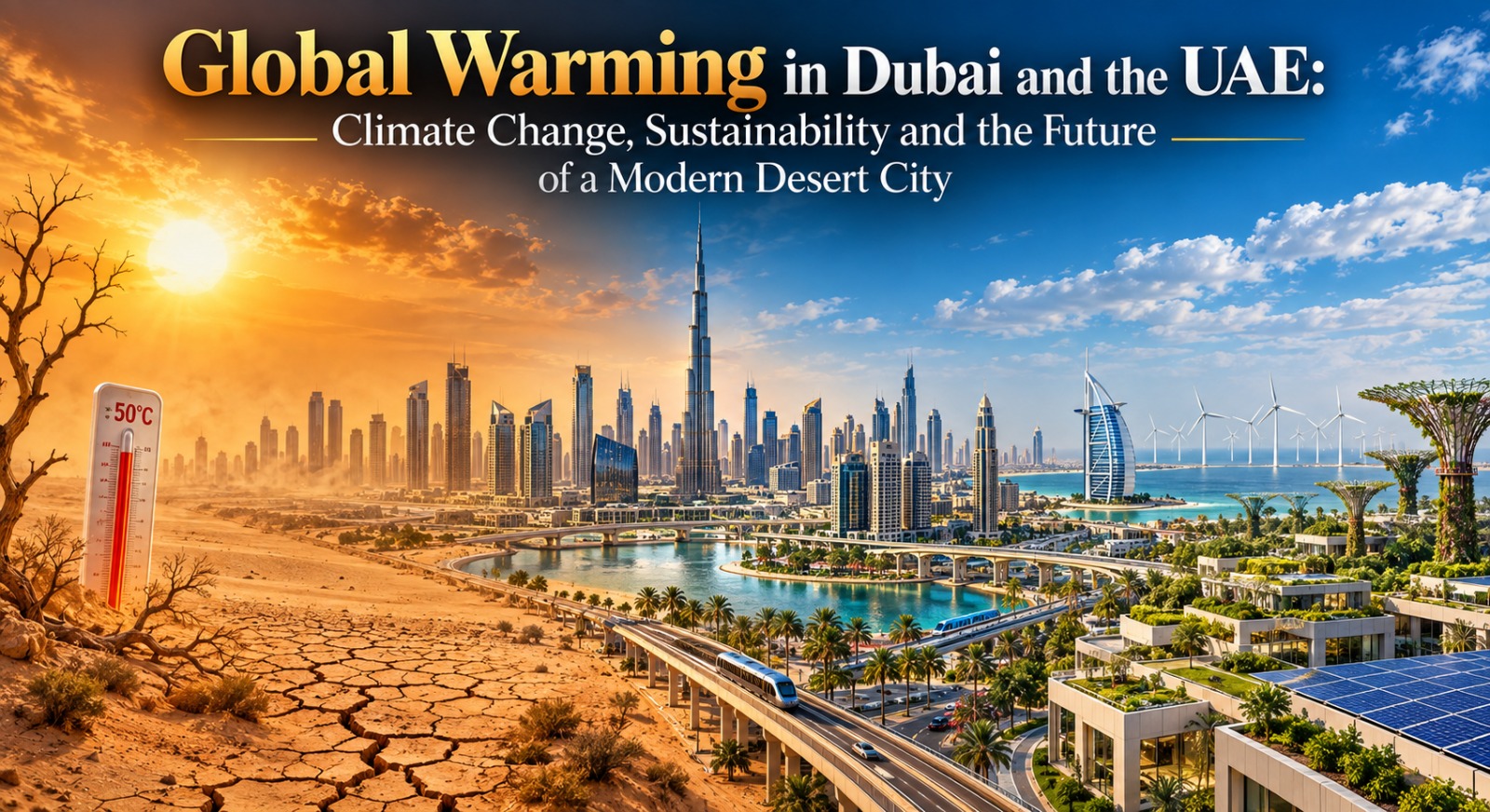
Introduction: Global Warming and Dubai’s Changing Future
Global warming is one of the defining environmental challenges of the 21st century. For Dubai and the United Arab Emirates, climate change has particular significance because the country combines a hot and arid climate with rapid urban development, population growth, extensive infrastructure, international tourism, logistics, aviation, real estate and high energy demand.
Dubai has developed from a regional trading centre into a global business, tourism, investment and technology hub. Its skyline, infrastructure, transportation networks, residential communities, commercial districts and hospitality sector reflect decades of rapid economic development. However, continued development also makes sustainability, climate resilience and responsible resource management increasingly important.
The UAE’s National Climate Change Plan identifies risks including extreme heat, water stress, sea-level rise, storm surge, dust and sandstorms, desertification and impacts on infrastructure, ecosystems, agriculture, food security and public health.
Global warming therefore is not simply an environmental subject. For Dubai, it is also connected with real estate, infrastructure, energy, water, transportation, tourism, investment and long-term economic planning.
The important question is not whether Dubai should continue developing. The question is how a rapidly growing desert city can continue creating economic opportunities while becoming more resource-efficient and resilient to changing environmental conditions.
Understanding Global Warming in the UAE
Global warming refers to the long-term increase in Earth’s average temperature, primarily associated with the accumulation of greenhouse gases in the atmosphere. Climate change is the broader phenomenon resulting from this warming and includes changes in temperature, precipitation, extreme weather patterns, sea levels and other environmental conditions.
The UAE’s geographical location makes heat particularly important. Dubai already experiences very high summer temperatures, meaning additional warming can place greater pressure on cooling systems, electricity consumption, outdoor activities, transportation infrastructure and human comfort.
The UAE’s National Climate Change Plan specifically identifies extreme heat and water stress among the country’s climate-related vulnerabilities.
This makes climate adaptation especially important for cities such as Dubai.
Adaptation means preparing buildings, infrastructure, communities and businesses for environmental conditions that may occur in the future. Mitigation, meanwhile, involves reducing greenhouse-gas emissions and increasing the use of cleaner energy and more efficient technologies.
Dubai’s climate strategy therefore involves both dimensions: reducing environmental impact while preparing the city for future climate conditions.
Why Global Warming Matters to Dubai
Dubai’s economy depends on highly developed infrastructure. Electricity, cooling, water production, transportation, construction, logistics, aviation, hospitality and commercial buildings all require significant resources.
During the hottest months, air conditioning becomes essential for homes, offices, shopping centres, hotels, warehouses and other buildings. As temperatures rise, maintaining comfortable indoor environments can place additional demands on cooling systems and electricity networks.
This makes energy efficiency an important component of sustainable development.
Buildings designed with appropriate insulation, high-performance glazing, efficient cooling systems, smart controls and energy-management technologies can reduce unnecessary energy consumption. Building owners can also improve existing properties through retrofitting and modernisation.
For Dubai’s real estate sector, sustainability is therefore increasingly connected with long-term asset management.
A building is not simply a structure constructed for today’s market. It can remain operational for decades. Decisions regarding its design, materials, cooling systems, water consumption and energy efficiency can therefore influence its environmental and operating performance throughout its life.
Renewable Energy and Dubai’s Solar Potential
One of Dubai’s major advantages in the transition toward cleaner energy is its abundant sunlight.
The UAE has invested heavily in renewable and clean-energy infrastructure, while Dubai has developed major solar-energy projects. The Mohammed bin Rashid Al Maktoum Solar Park is a central component of this effort.
According to DEWA, the solar park’s total production capacity has reached 3,860 MW and is planned to exceed 8,000 MW by 2030. DEWA also states that clean energy represents more than 21.5% of its total capacity and is targeted to reach 36% by 2030.
Dubai’s clean-energy objectives are part of a broader strategy. DEWA states that Dubai’s long-term target is for 100% of its energy production capacity to come from clean energy sources by 2050.
Solar energy is particularly relevant to a desert economy because it can convert one of the region’s most abundant natural resources—sunlight—into electricity.
The continuing expansion of solar generation, energy storage, smart-grid technology and energy efficiency can help create a more diversified energy system.
For investors and businesses, this transition also creates opportunities in renewable energy, energy management, sustainable construction, smart infrastructure and clean technologies.
Sustainable Buildings and Dubai Real Estate
The real estate industry has an important role in Dubai’s response to climate change.
Buildings consume energy throughout their operational lives. Cooling, lighting, ventilation, water heating, elevators and other building systems all contribute to resource consumption.
Sustainable real estate does not necessarily mean simply adding environmentally friendly features to a building. It involves considering environmental performance throughout the development process—from land planning and architectural design to construction, operation, renovation and eventual redevelopment.
Developers can consider:
- Energy-efficient air-conditioning systems
- High-quality insulation
- Efficient windows and glazing
- Smart lighting
- Building-management systems
- Solar-energy integration
- Water-efficient fixtures
- Smart irrigation
- Sustainable construction materials
- Efficient waste management
- Shaded outdoor spaces
- Climate-resilient landscaping
- EV charging infrastructure
Smart-building technology can provide another important advantage. Digital systems can monitor electricity and water consumption and identify areas where resources are being used inefficiently.
For commercial real estate, this can connect environmental performance with operational efficiency.
For residential properties, efficient design can contribute to better indoor comfort and potentially lower resource consumption.
For investors, climate resilience can become an increasingly relevant consideration when assessing the long-term performance of property assets.
Water Security: A Critical Climate Issue for the UAE
Water security is one of the most important sustainability issues facing the UAE.
The country has limited natural freshwater resources and relies heavily on desalination to provide potable water.
Desalination has enabled the UAE to support a growing population and modern economy, but producing water requires energy. This creates an important relationship between water security and energy strategy.
Greater energy efficiency, renewable electricity and improvements in desalination technologies can therefore have environmental significance.
Dubai is also exploring technologies designed to improve the sustainability of water production. DEWA has identified seawater reverse osmosis and renewable-energy-powered desalination among the technologies associated with its longer-term sustainability objectives.
Water conservation remains equally important.
Smart irrigation systems can reduce unnecessary consumption in landscaped areas. Treated or recycled water can be used for appropriate non-potable applications. Buildings can incorporate water-efficient fixtures and monitoring systems.
In a desert environment, every improvement in water efficiency can contribute to long-term resilience.
Green Spaces and Urban Heat in Dubai
Urban development can influence local temperatures. Roads, buildings and other hard surfaces can absorb and retain heat, while vegetation and shade can improve outdoor conditions.
Dubai has invested heavily in landscaping and green urban environments despite its desert climate.
Trees and suitable vegetation can provide shade and contribute to more comfortable public spaces. However, landscaping in an arid environment needs to consider water availability and plant suitability.
Climate-resilient landscaping should prioritise plants that can tolerate local conditions and irrigation systems that minimise unnecessary water consumption.
Future urban design can also incorporate shaded pedestrian routes, covered public areas and carefully planned green spaces.
These measures can improve the usability of outdoor environments while contributing to broader urban resilience.
Transportation and Climate Change in Dubai
Transportation is another important component of Dubai’s sustainability journey.
Dubai has developed an extensive public transportation network that includes the Metro, tram, buses, taxis and marine transportation. Public transport can provide alternatives to private vehicle use and support efficient urban mobility.
Electric vehicles are also becoming increasingly important in the global transition toward lower-emission transportation.
As electric mobility expands, charging infrastructure will become an increasingly important part of urban planning.
Smart traffic-management systems can further improve transportation efficiency by using technology to manage traffic flows and reduce unnecessary delays.
Dubai’s role as an international aviation and logistics hub adds another dimension.
Air transport, shipping and freight are essential to the city’s economy but are also difficult sectors to decarbonise. Continued technological innovation will therefore be important in areas such as cleaner fuels, electric mobility, energy efficiency, route optimisation and sustainable logistics.
Dubai, Tourism and Sustainable Hospitality
Tourism is a major component of Dubai’s international economy.
The city attracts visitors through its hospitality, shopping, business events, entertainment, beaches, architecture and global connectivity.
Climate change creates both challenges and opportunities for the tourism sector.
Hotels, resorts, restaurants and entertainment venues consume electricity and water, particularly in a hot climate where cooling is essential.
Sustainable hospitality can address these challenges through:
- Energy-efficient cooling
- Smart building controls
- Water-efficient systems
- Renewable energy
- Waste reduction
- Food-waste management
- Sustainable procurement
- Efficient lighting
- Responsible landscaping
Sustainability can increasingly become part of corporate strategy rather than simply a marketing message.
For international visitors and global businesses, environmental performance can also become one factor in how destinations and companies are evaluated.
Dubai’s international profile provides an opportunity to demonstrate how a major tourism destination can combine hospitality and environmental responsibility.
Climate Change and the Future of Dubai’s Economy
Climate change is not only an environmental issue. It can also influence economic planning.
Dubai’s economy includes real estate, finance, tourism, logistics, aviation, trade, technology and professional services. Each sector depends on reliable infrastructure and efficient access to energy, water and transportation.
Climate resilience can therefore become part of long-term economic resilience.
Investors may increasingly examine factors such as:
- Energy efficiency
- Building quality
- Location resilience
- Water efficiency
- Infrastructure connectivity
- Operating costs
- Sustainability standards
- Access to clean energy
- Long-term adaptation requirements
For property developers, this means sustainability should increasingly be considered during the earliest stages of project planning.
For businesses, measuring environmental performance can help identify opportunities to improve resource efficiency.
For investors, understanding climate-related risks can contribute to more informed long-term asset planning.
Innovation: Turning Climate Challenges into Opportunities
The UAE’s experience provides an interesting case study in how a hot and arid country can use technology to address environmental challenges.
Solar power is one example.
Desalination is another.
Energy-efficient cooling, smart buildings, intelligent transportation, water recycling and climate-resilient urban planning represent additional areas of innovation.
The UAE’s National Climate Change Plan was designed in part around the principle of turning climate risks into opportunities.
This approach is particularly relevant to Dubai because the city’s economic model has historically been connected with innovation, international investment and infrastructure development.
Technologies developed for Dubai’s desert environment could potentially have applications in other hot and water-stressed regions.
This creates opportunities not only for government institutions but also for private companies, developers, engineers, technology providers, investors and entrepreneurs.
The Role of Education and Public Awareness
No climate strategy can succeed through infrastructure alone.
Education and public awareness are equally important.
Schools and universities can teach students about climate science, energy efficiency, water conservation and responsible resource use.
Businesses can train employees to reduce unnecessary energy and water consumption.
Individuals can make practical decisions such as avoiding unnecessary electricity use, conserving water, reducing waste, recycling appropriate materials and using public transportation when practical.
Small actions become more meaningful when they are multiplied across millions of residents, workers and visitors.
Climate responsibility therefore involves governments, businesses, investors, communities, educational institutions and individuals.
What Sustainable Development Means for Dubai’s Real Estate Future
As a real estate professional, I believe the relationship between sustainability and property development deserves particular attention.
Dubai’s property market is closely connected with the city’s future infrastructure, population growth and international investment.
A property is a long-term asset. Its performance is influenced not only by location and design but also by operating costs, infrastructure, accessibility, building quality and resilience.
Future real estate development can increasingly incorporate sustainability from the beginning rather than treating it as an additional feature at the end of a project.
This could include better building orientation, efficient cooling, smart energy systems, renewable-energy integration, water conservation, sustainable materials, shaded public spaces and intelligent mobility solutions.
Sustainable development should not mean stopping economic growth. Instead, it can mean designing growth more efficiently.
Dubai’s challenge—and opportunity—is to continue developing while using energy, water, land and infrastructure responsibly.
Dubai’s Climate Future: Building a Resilient Desert City
Dubai’s future will be shaped by its ability to combine economic ambition with environmental resilience.
The city has already developed significant clean-energy infrastructure, and official plans continue to focus on renewable energy, efficiency, smart infrastructure and net-zero objectives. DEWA reports that its smart-grid programme includes AED 7 billion of investment and is designed to support advanced electricity and water infrastructure.
The challenge ahead is substantial.
Dubai must continue accommodating economic growth while managing energy demand, water consumption, transportation requirements, construction activity and environmental pressures.
But these challenges also create opportunities.
They can encourage innovation in:
- Clean energy
- Smart buildings
- Sustainable real estate
- Water technology
- Electric mobility
- Green logistics
- Climate-resilient infrastructure
- Energy-efficient cooling
- Urban landscaping
- Waste management
The result can be a more efficient and resilient urban economy.
Conclusion: Dubai and the UAE’s Role in a Changing Climate
Global warming is a worldwide challenge, but its effects and solutions are experienced locally.
For Dubai and the UAE, climate change is particularly significant because of the country’s hot desert environment, limited natural freshwater resources, rapid urbanisation and globally connected economy.
At the same time, the UAE has significant opportunities to develop solutions through renewable energy, advanced desalination, sustainable buildings, smart infrastructure, efficient transportation and climate-resilient urban planning.
Dubai’s development demonstrates that economic ambition and environmental responsibility do not have to be treated as completely separate objectives.
The future of Dubai can increasingly be shaped around efficient energy use, responsible water management, sustainable construction, clean technology and resilient infrastructure.
The UAE’s experience may also offer lessons to other countries facing similar challenges in hot and arid environments.
For the real estate sector, sustainability can become an increasingly important part of long-term property planning. For businesses, it can become part of operational strategy. For investors, climate resilience can become another factor in evaluating long-term assets. For individuals, responsible resource use can become part of everyday life.
Ultimately, addressing global warming requires cooperation between governments, businesses, scientists, investors, communities and individuals.
I believe Dubai’s future can demonstrate that innovation, economic development, environmental responsibility and climate resilience can advance together for the benefit of present and future generations.