
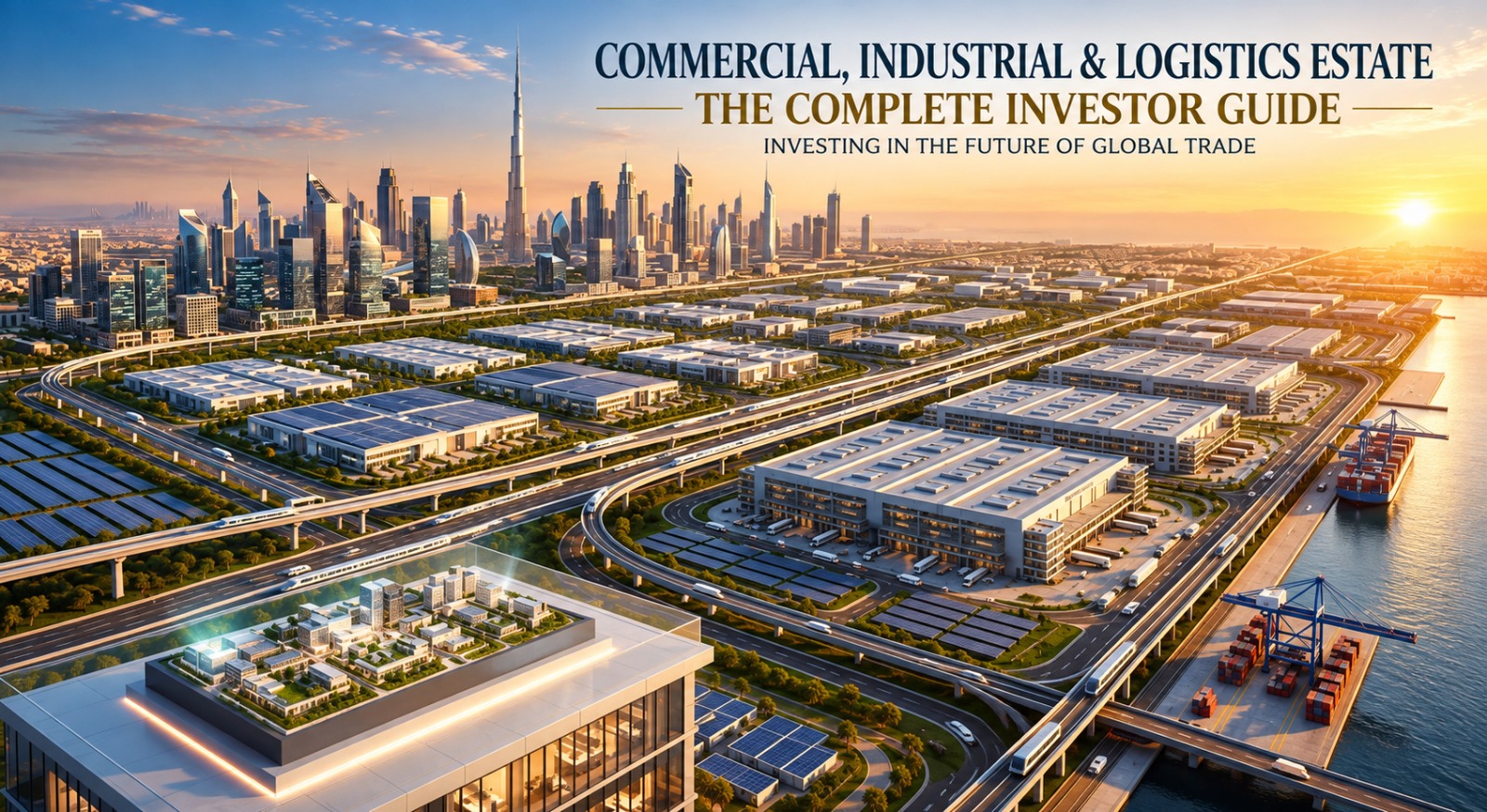
By Nasir Mahmood Siddiqui
CEO, Touchwood Real Estate Brokers, Dubai
When people talk about Dubai real estate, the conversation almost always turns to soaring residential towers or luxury beachfront villas. But behind the glitz lies one of the most reliable wealth-generation engines in the region: commercial, industrial, and logistics property.
These sectors sit at the very heart of Dubai’s economic engine—trade, global distribution, e-commerce, and corporate regional headquarters.
As Dubai solidifies its status as a premier global logistics hub, demand for modern warehouses, industrial land, prime office space, and specialized retail hubs continues to evolve. Whether you are an institutional investor, a business owner looking for a operational home, or a private investor seeking resilient yields, this guide breaks down the ten fundamental themes defining Dubai’s commercial property landscape.
1. The Future of Commercial Real Estate in Dubai
Dubai’s commercial market is undergoing a clear structural transformation. The old playbooks—buying a standard unit in a generic office tower and waiting for appreciation—no longer apply.
Modern occupiers are far more selective. They prioritize spatial efficiency, building performance, and location over vanity addresses. The rise of hybrid working models means companies aren’t necessarily cutting space outright; instead, they are upgrading the quality of their footprints.
- The Quality Divide: Premium Grade A office space in core business districts continues to see tight vacancy rates and strong rental growth. Conversely, older, poorly maintained secondary stock faces downward yield pressure.
- Mixed-Use Integration: Single-purpose business parks are giving way to vibrant mixed-use communities that offer lifestyle amenities alongside office space.
Key Takeaway: Dubai’s commercial market is maturing fast. Flight to quality is real, and the gap between prime and secondary assets will continue to widen.
2. Dubai Industrial Property: The High-Yield Opportunity
Industrial real estate has quietly shifted from a niche segment to the absolute center of Dubai’s investment narrative. Strong trade volumes, light manufacturing growth, expanding e-commerce networks, and government infrastructure backing all drive this momentum.
The industrial ecosystem spans:
- Cold storage and specialized climate-controlled units
- Light industrial units (LIUs) and assembly plants
- Modern logistics parks
- Raw industrial land plots
Supply is entering the market, but the vast majority of new builds cater strictly to modern specifications. This leaves a shortage of top-tier facilities while pushing older, lower-spec industrial units to the margins.
Key Takeaway: Structural trade flows and regional economic strategies guarantee long-term industrial demand, but layout specifications determine your actual occupancy rates.
3. Warehousing and Logistics: Key Market Trends
Logistics is currently one of the highest-performing commercial segments in the UAE. Driven by third-party logistics (3PL) providers, global retailers, and regional distributors, the demand for well-located storage facilities is at an all-time high.
Here is what modern corporate tenants are demanding:
- Higher Clear Heights: Occupiers want vertical volumetric space (often 10m–12m+ clear heights) to maximize pallet capacity.
- Super-Flat Flooring & Heavy Loading: Essential for high-reach forklifts and automated storage systems.
- Power Capacity: High power allocations are vital for modern manufacturing, processing, and cold storage setup.
- Strategic Access: Immediate proximity to arterial corridors (like Sheikh Mohammed Bin Zayed Road and Emirates Road) and ports.
Key Takeaway: High rental growth in prime logistics areas rewards landlords who build or acquire assets meeting strict modern technical standards.
4. Why Dubai Commands the Global Logistics Landscape
Dubai’s emergence as a global trade nerve center is no accident; it is the outcome of intentional, multi-decade infrastructure investments.
Dubai Global Logistics Hub
Geographic Position
- 8-hour flight radius to 2/3 world population
- Bridge between East & West
Infrastructure Assets
- Jebel Ali Port
- Al Maktoum Intl
- DWC Airport
- Arterial road highways
Business Environment
- Free Zone ownership
- Tax-efficient
- Stable legal framework
When you combine world-class port infrastructure with air connectivity and business-friendly free zone regulations, you get an operational environment that competing regional markets simply cannot replicate overnight.
Key Takeaway: Dubai’s position as a cross-continent distribution node creates an irreplaceable foundation for commercial space demand.
5. Jebel Ali: The Strategic Core of Industrial Real Estate
If Dubai’s commercial market has an anchor, it is Jebel Ali. Home to Jebel Ali Port and the vast JAFZA (Jebel Ali Free Zone) ecosystem, this cluster remains the absolute benchmark for industrial investment.
- Connectivity: Direct sea-to-air corridors via Jebel Ali Port and nearby Al Maktoum International Airport (DWC).
- Synergy: Surrounding corridors like Dubai South, DIP (Dubai Investments Park), and DIC (Dubai Industrial City) benefit directly from Jebel Ali’s trade density.
- Pricing Dynamics: Given its strategic dominance, entry prices for freehold and leasehold assets here reflect a premium, but tenant retention remains among the strongest in the region.
Key Takeaway: Jebel Ali and its surrounding industrial corridors represent the most liquid industrial property market in the emirate.
6. Strategic Location Clusters: Ports, Airports, and Highways
Logistics property value is tied directly to location. Dubai’s market is organized into distinct functional clusters:
| Location Cluster | Primary Asset Types | Key Target Occupiers | Primary Advantage |
| Port-Linked (e.g., JAFZA) | Large-scale warehouses, distribution yards | Heavy importers/exporters, 3PLs, shipping lines | Direct sea freight integration & customs benefits |
| Airport-Linked (e.g., Dubai South, Cargo Village) | High-spec fulfillment, air cargo facilities | Time-sensitive freight, pharma, high-value goods | Fast turnaround and direct apron/airside access |
| Highway Corridors (e.g., DIP, DIC, Al Quoz) | Light industrial, show-warehouses, manufacturing | Domestic distributors, last-mile fleets, services | Seamless connectivity to all UAE emirates |
Key Takeaway: Align your real estate acquisition with the specific operational needs of your target tenant profile.
7. Due Diligence Checklist for Warehouse Investors
Investing in Dubai warehouses delivers attractive yields, but executing a profitable acquisition requires rigorous due diligence.
Investor Checklist
Specification Metrics
- Clear height
- Power capacity
- Loading bays
Regulatory Status
- Freezone vs Mainland
- Zoning codes
Tenant Profile & Covenant
- Multinational vs Local SME
- Credit rating
Lease Structure
- Net vs Gross
- Escalation %
- Service charges
Building Condition
- Deferred maintenance
- CapEx needed
- Building Specifications: Ensure floor loading capacity, eaves height, power allocation (in kW), and fire suppression systems meet modern Civil Defence standards.
- Jurisdiction: Know whether the asset sits in a Free Zone or Mainland. This dictates target tenant business licensing and ownership structures.
- Lease Structure: Single-tenant net leases offer low-management, predictable cash flow, whereas multi-tenant industrial parks carry higher operational overhead but offer yield upside.
- Submarket Supply: Always analyze the surrounding development pipeline to ensure new supply won’t undercut your rental rates.
8. Navigating Commercial Asset Classes
Diversification across different commercial property types is an effective strategy to hedge risk in a growing market:
- Grade A Offices: Lower yields, but longer leases, blue-chip corporate tenants, and minimal vacancy risk.
- Prime Logistics & Warehousing: High demand, strong yield profiles, and stable cash flows driven by long-term corporate leases.
- Neighborhood Retail & Community Centers: Dependent on local residential density; high-performing when anchored by essential services like supermarkets and pharmacies.
- Industrial Plots & Facilities: Higher entry complexity, but delivers strong, sticky income from specialized manufacturing operators.
9. The E-Commerce Engine Driving Last-Mile Demand
The rapid growth of regional e-commerce has fundamentally reshaped Dubai’s industrial layout. Online retail relies on a multi-tiered fulfillment strategy:
Mega Distributor → Regional Fulfillment → Urban Last-Mile Hub
Mega Distributor
- Large regional setup
- Outskirts / Freezones
Regional Fulfillment
- Mid-sized sorting facility
- Mid-ring industrial
Urban Last-Mile Hub
- Small, central depot
- Near population centers
This model has created intense competition for well-located “last-mile” urban logistics space near major population centers like Al Quoz and Ras Al Khor. E-commerce operators value delivery speed above all else, making proximity to residential hubs a premium feature.
Key Takeaway: The demand for urban, last-mile sorting nodes offers landlords an opportunity to achieve higher rental rates per square foot.
10. Industrial Land Development in Dubai
For institutional developers and high-net-worth investors, acquiring industrial raw land offers high upside—along with specialized development risks.
Before acquiring industrial land in Dubai, evaluate these key factors:
- Infrastructure Readiness: Confirm water, high-voltage power connections, sewage networks, and heavy-vehicle access roads are already present or committed by authorities.
- Zoning Rules: Verify plot coverage ratios (FAR/FAR limits), maximum height allowances, and approved usage codes (light industrial vs. heavy industrial vs. commercial).
- Land Tenure: Understand whether the parcel is held on a freehold basis or long-term authority lease (e.g., Dubai Development Authority, Dubai South, or JAFZA).
Key Takeaway: Land development offers substantial capital margin, but your financial projections must account for utility connection timelines and municipal approval processes.
10 Rules for Commercial Real Estate Investors in Dubai
- Prioritize Specs Over Aesthetics: Heavy power supply, ceiling clearance, and floor loading capacity drive warehouse rents—not decorative facades.
- Understand the Location Hierarchy: Port-adjacent space, airport corridors, and inland hubs serve entirely different end-users.
- Analyze the Submarket Pipeline: Track upcoming completions within a 5 km radius to prevent localized oversupply risks.
- Verify Regulatory Setup: Match the asset type with modern legal frameworks (Mainland vs. Free Zone regulations).
- Protect Net Yields: Calculate service charges, ground rents, and maintenance reserves upfront to know your true net return.
- Focus on Tenant Credit Quality: Secure long-term leases with established corporate covenants to minimize vacancy risk.
- Budget for Modernization: Factor in retrofitting expenses for older stock to meet contemporary fire safety and operational standards.
- Leverage the Last-Mile Trend: Infill sites near residential hubs command higher rates per square foot due to delivery demands.
- Verify Infrastructure Commitments: Confirm power and utility connections with local authorities before closing land deals.
- Build a Balanced Portfolio: Spread investments across offices, industrial spaces, and logistics assets to hedge against localized market shifts.
Partner With Commercial Property Experts
Navigating Dubai’s commercial, industrial, and logistics property market requires clear, local market intelligence. From sourcing off-market warehouse portfolios to securing prime Grade A office space or strategic industrial land, Touchwood Real Estate Brokers delivers clear, end-to-end investment advisory tailored to your financial targets.
Ready to explore commercial property opportunities in Dubai?
Contact our commercial advisory team at Touchwood Real Estate to discuss your portfolio strategy today.
Frequently Asked Questions
What are the main commercial property types in Dubai?
The market consists of Grade A and secondary office spaces, retail assets (malls and community centers), light industrial units, and specialized logistics/warehousing facilities.
Why is Dubai considered a primary global logistics hub?
Dubai offers an unmatched combination of strategic location, world-class port infrastructure (Jebel Ali), major air cargo hubs (DXB and DWC), seamless road networks, and tax-efficient free zones.
What key specifications should I evaluate in a Dubai warehouse?
Look at ceiling clear height (minimum 8m–10m for modern logistics), floor loading capacity, available power allocation (kW), loading bay counts, and Civil Defence-approved fire systems.
What is the difference between Free Zone and Mainland commercial property?
Free Zone properties allow 100% foreign corporate ownership and offer specific tax and customs benefits, making them ideal for re-export and global firms. Mainland properties allow businesses to trade directly with the local UAE market without restrictions.
Are Grade A offices outperforming older commercial stock in Dubai?
Yes. Modern companies prioritize quality, spatial efficiency, and building management. Grade A properties currently maintain lower vacancy rates and secure stronger rental appreciation than older secondary stock.