
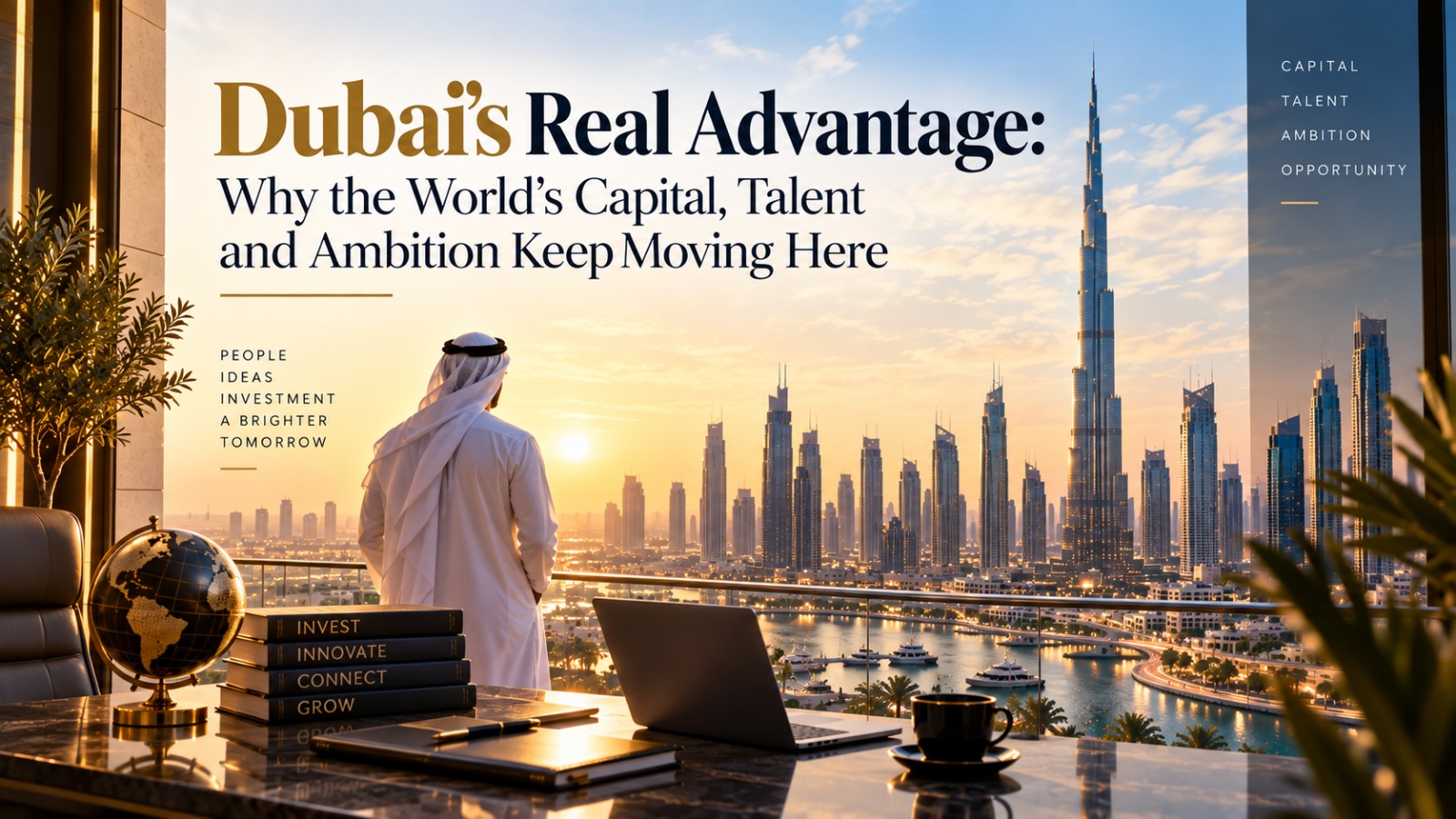
How Dubai turned speed, connectivity, stability and opportunity into one of the world’s most powerful economic models
By Nasir Siddiqui
Dubai’s Economic Model: Why Global Investors, Talent and Capital Choose Dubai
Discover how Dubai built a global economic model around speed, connectivity, investment, innovation and long-term residency, and why investors and entrepreneurs continue to choose the UAE.
Dubai Does Not Wait for the Future
Most cities respond to change.
Dubai tries to arrive before it.
That difference explains much of the emirate’s extraordinary transformation over the past few decades.
What was once a regional trading centre has become one of the world’s most connected business, investment, tourism and lifestyle destinations. Its skyline is impressive, but the buildings are only the visible part of the story.
Behind them is something more important: a system designed to move people, money, businesses and ideas quickly.
Under the vision of His Highness Sheikh Mohammed bin Rashid Al Maktoum, Dubai has pursued an economic philosophy built around openness, infrastructure, innovation, international connectivity and long-term ambition.
The result is an economy that increasingly competes not simply on cost, but on something far more valuable to global entrepreneurs and investors:
Time
1. Time Has Become Dubai’s Most Valuable Economic Asset
In modern business, time is not merely a convenience.
It is capital.
Every unnecessary delay can mean a missed transaction, a lost opportunity or a decision postponed.
Dubai has built much of its infrastructure around reducing those delays.
From airports and highways to digital government services, property registration, banking, logistics and hospitality, the emirate has invested heavily in making everyday transactions faster and more predictable.
This is particularly important for entrepreneurs, investors and executives whose decisions can involve millions of dirhams and international operations.
Dubai’s premium services and sophisticated infrastructure therefore represent more than luxury.
They represent efficiency.
And efficiency has become one of the city’s strongest competitive advantages.
2. The Golden Visa Changed the Investment Conversation
Dubai’s appeal is not limited to business.
For international investors, the ability to establish a long-term presence matters enormously.
The UAE Golden Visa has become an important part of that proposition.
For qualifying real estate investors, a property investment valued at AED 2 million or more can support eligibility for a 10-year Golden Visa, subject to the applicable rules, documentation and approvals.
That distinction is important.
The qualifying threshold is AED 2 million in real estate investment value. It should not be confused with the amount initially paid to a developer.
For eligible off-plan property, there is no general rule that simply paying 20% qualifies an investor for the Golden Visa. The property itself must meet the applicable AED 2 million threshold, together with the relevant UAE requirements.
This has helped change the way international buyers look at Dubai property.
A property purchase can potentially represent not only an investment, but also a long-term connection to the UAE.
For entrepreneurs, families and high-net-worth individuals, that stability can be highly valuable.
3. Dubai Became a Gateway Between East and West
Geography gave Dubai an advantage.
Infrastructure turned that advantage into an economic engine.
Located between major markets across Asia, the Middle East, Africa and Europe, Dubai has positioned itself as a natural meeting point for international commerce.
But modern connectivity goes far beyond physical travel.
A business owner in India can build a Dubai-based company.
An investor in Europe can own Dubai real estate.
A technology entrepreneur in North America can sell services into the UAE.
A family can live in Dubai while maintaining business interests across several continents.
Dubai increasingly functions as a global operating platform, rather than simply a destination.
That distinction is crucial.
4. The New Dubai Economy Is Far Bigger Than Oil
Dubai’s economic transformation is perhaps best understood through diversification.
The emirate is now driven by a broad range of sectors, including:
- Real estate
- Tourism and hospitality
- Aviation
- International trade
- Logistics
- Financial services
- Technology
- Professional services
- Commodities
- Construction and infrastructure
- Media and creative industries
Oil is no longer the defining narrative of Dubai.
Diversification is.
The strategy has been remarkably consistent: identify areas of global demand, build the infrastructure required to support them, create an environment attractive to international companies, and connect those businesses to the wider world.
5. Free Zones Created a Global Business Ecosystem
Dubai’s free zones have played a major role in this transformation.
Instead of trying to build one economic model for every industry, the emirate developed specialised business environments designed around different sectors.
Technology, finance, commodities, media, logistics and other industries have been given platforms where international companies can establish operations and connect with global markets.
This has created something larger than a collection of business districts.
It has created an ecosystem.
Once companies, investors, professionals and service providers begin concentrating in the same environment, opportunities multiply.
One company creates demand for another.
One investor brings another investor.
One entrepreneur creates a network that attracts additional talent.
That network effect is one of Dubai’s greatest economic strengths.
6. Gold Helped Build Dubai’s Global Trading Identity
Long before Dubai became synonymous with luxury real estate and skyscrapers, it was known for trade.
Gold remains an important part of that identity.
The emirate has developed a sophisticated ecosystem around precious metals and commodities, supported by trading companies, financial institutions, logistics providers, refiners and specialist infrastructure.
The Dubai Multi Commodities Centre (DMCC) has become one of the most recognisable pillars of this commodities ecosystem.
The broader lesson is more important than gold itself.
Dubai has repeatedly taken a strategic advantage, built infrastructure around it, introduced stronger regulation and connected it to international markets.
That formula has been applied across multiple sectors.
7. Regulation Became Part of Dubai’s Global Ambition
Rapid economic growth inevitably brings greater international scrutiny.
As Dubai and the UAE became increasingly important to global finance, property and commodities, expectations around transparency, compliance and financial regulation also increased.
The UAE’s removal from the Financial Action Task Force’s increased-monitoring list in February 2024 marked an important milestone in that journey.
The country’s efforts included strengthening anti-money-laundering controls, financial supervision, beneficial-ownership requirements, enforcement and international cooperation.
For international investors, this matters.
Global capital increasingly demands not only opportunity, but confidence.
A world-class financial and investment centre needs both.
Dubai’s continuing development of its regulatory infrastructure is therefore part of its evolution from a regional trading hub into a mature global economic centre.
8. Dubai Sells More Than Luxury—It Sells Access
The international image of Dubai often focuses on its spectacular skyline.
The Burj Khalifa.
Palm Jumeirah.
Luxury hotels.
Supercars.
Yachts.
Five-star experiences.
All of these are real, but they represent only the surface.
Dubai’s deeper proposition is access.
Access to international markets.
Access to modern infrastructure.
Access to business networks.
Access to global talent.
Access to a highly connected lifestyle.
And, for those who qualify, access to long-term residency.
This is why Dubai appeals to a much wider audience than traditional luxury buyers.
It appeals to people who want to build.
9. Real Estate Has Become Part of a Larger Investment Story
Dubai real estate is often discussed purely in terms of prices, rents and capital appreciation.
That is too narrow.
For international investors, property can sit inside a much larger financial and lifestyle decision.
An investor may be considering:
Asset value + rental income + capital appreciation + residency + lifestyle + global connectivity.
That combination helps explain why Dubai continues to attract international property capital.
The city’s real estate market is no longer simply about owning an apartment or villa.
For many international buyers, it is about establishing a strategic position in one of the world’s most connected cities.
10. Dubai’s Next Chapter Will Be About What Comes After Today
Dubai’s greatest strength may be that it does not behave like a finished city.
It continues to build.
Artificial intelligence, digital assets, financial technology, tourism, logistics, sustainable infrastructure and advanced urban development are becoming increasingly important to the emirate’s future.
The same philosophy that transformed Dubai’s traditional economy is now being applied to emerging industries:
anticipate demand, build infrastructure, attract talent, create an ecosystem and connect it to the world.
There will be challenges.
Global competition will intensify.
Regulatory expectations will continue to rise.
International capital will become increasingly selective.
But Dubai has repeatedly demonstrated an ability to adapt to changing circumstances.
The Real Dubai Advantage
Dubai’s greatest achievement is not a particular tower, airport, free zone or property development.
It is the ecosystem connecting all of them.
The city has created an environment where capital can move, businesses can connect, talent can relocate, families can establish themselves and entrepreneurs can think internationally.
And underneath all of it is a simple economic principle:
Make it easier for productive people to do productive things.
That may ultimately be Dubai’s most powerful competitive advantage.
The skyline attracts attention.
The infrastructure creates confidence.
The regulatory framework creates credibility.
The connectivity creates opportunity.
And the speed creates momentum.
Dubai did not simply build a modern city.
It built a platform for the future.
And perhaps that is why, even after everything it has already achieved, the most interesting chapter of Dubai’s story may still be ahead.