
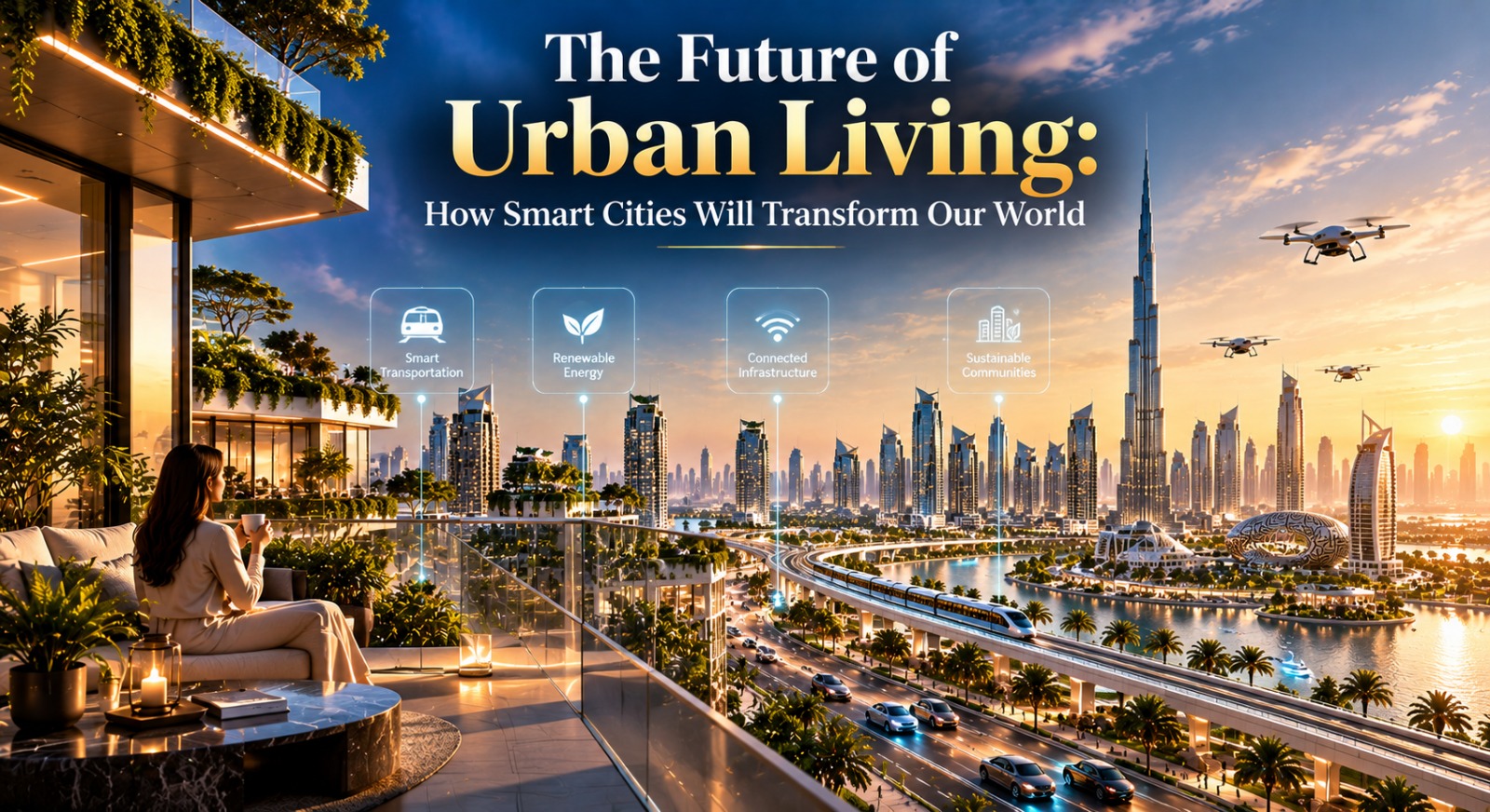
The future of urban living is no longer a distant concept reserved for science fiction. Around the world, cities are becoming more connected, data-driven and focused on sustainability. Artificial intelligence (AI), the Internet of Things (IoT), renewable energy, smart buildings and intelligent transportation are beginning to influence how urban areas are planned, developed and managed.
As populations grow and cities face pressure on housing, transportation, energy, water and public services, the challenge is no longer simply how to build larger cities. The more important question is how to build better cities—places that are efficient, sustainable, connected and capable of supporting a high quality of life.
For the real estate industry, this transformation is particularly important. Property does not exist in isolation. Its long-term value is closely connected to infrastructure, transportation, employment opportunities, technology, sustainability and the quality of the surrounding community.
What Makes a City Smart?
A smart city uses technology, data and modern infrastructure to improve the way an urban environment operates.
Sensors can monitor traffic, energy consumption, water systems, waste collection and environmental conditions. Connected infrastructure can provide information in real time, while artificial intelligence can help city authorities identify patterns and make more informed decisions.
The objective, however, should not be technology for its own sake. A successful smart city uses technology to solve practical problems and improve everyday life.
For example, intelligent waste-management systems can help determine when collection is actually required. Smart water networks can identify potential leaks. Connected street lighting can respond to movement and environmental conditions. These applications can improve efficiency while potentially reducing operating costs and resource consumption.
Artificial Intelligence and the Internet of Things
AI and IoT are likely to become two of the most important technologies shaping future urban development.
The Internet of Things connects physical devices and infrastructure to digital networks. Buildings, vehicles, sensors, utility systems and other assets can generate data about how they are being used.
Artificial intelligence can then analyse this information and identify patterns that may not be obvious to humans.
In urban planning, this could support better traffic management, energy planning, infrastructure maintenance and emergency response. For property developers, data can also provide a deeper understanding of how people move through and use buildings and communities.
The result could be a shift from reactive urban management toward more predictive and efficient systems.
Smart Buildings Are Changing Real Estate
The building of the future will be more than four walls, windows and mechanical systems.
Smart buildings can integrate lighting, cooling, security, access control, energy management and other functions into connected systems. Building-management technology can help monitor energy consumption and identify areas where efficiency can be improved.
This transformation affects almost every part of the property sector, including residential communities, offices, hotels, shopping centres, warehouses and industrial facilities.
For investors, the implications are significant. A building’s long-term attractiveness may increasingly depend not only on its location and design, but also on operating efficiency, digital connectivity, environmental performance and adaptability.
In industrial and logistics real estate, for example, smart systems can support warehouse automation, inventory management, security and energy efficiency.
Digital Twins and the Next Generation of Urban Planning
Another emerging technology is the digital twin—a virtual representation of a physical building, infrastructure system or urban environment.
Digital twins can allow planners and developers to test different scenarios before making major physical investments. A proposed development could potentially be assessed for traffic movement, energy consumption, infrastructure capacity or environmental impact in a digital environment.
This could make urban planning more analytical and reduce some of the risks associated with large-scale development.
For property investors, the broader principle is important: better information can lead to better decisions.
Sustainability Will Become Central to Urban Development
The future of urban living will also be shaped by climate and resource pressures.
Cities are major consumers of energy and resources, making sustainable development increasingly important. Future communities are likely to place greater emphasis on renewable energy, efficient buildings, green spaces, water management and resilient infrastructure.
Solar power, battery storage, smart grids, energy-efficient cooling and sustainable construction materials can all contribute to more efficient urban environments.
Green infrastructure can also play a role. Parks, trees, landscaped corridors, wetlands and other natural systems can help improve urban environments while supporting resilience against heat and flooding.
Sustainability should therefore be viewed not simply as an environmental objective, but as an important component of long-term urban planning and property development.
Transportation Will Redefine Urban Living
Transportation is one of the strongest forces shaping cities.
Electric vehicles, intelligent traffic systems, public transportation, shared mobility and eventually more autonomous transportation technologies could change how people travel and how cities are designed.
The concept of the “15-minute city,” where residents can reach many essential services within a relatively short walk or cycle, has also influenced discussions about future urban planning.
Better connectivity can have direct implications for real estate. Locations near efficient transport networks, employment centres and essential services can become increasingly attractive to residents and businesses.
The future city may therefore be less dependent on private car ownership and more focused on accessibility and connectivity.
Smart Logistics Will Reshape Industrial Real Estate
Urban growth is also changing the logistics sector.
The expansion of e-commerce and increasingly complex supply chains is creating demand for efficient warehouses, distribution centres and strategically located logistics facilities.
Technology can help companies optimise delivery routes, automate warehouses and monitor inventory. At the same time, cities may require more strategically positioned logistics hubs to support growing populations without increasing congestion.
This creates new opportunities for industrial and logistics real estate, particularly in locations with strong road, port, airport and public infrastructure connections.
Healthcare and Education Will Become More Connected
Smart-city technology will not be limited to transport and buildings.
Healthcare can increasingly use digital platforms, remote monitoring and connected devices to improve access and support patients. Education can benefit from digital learning platforms, artificial intelligence-assisted tools and flexible learning environments.
Technology, however, should complement—not replace—the human professionals responsible for healthcare and education.
The strongest smart cities will combine technological capability with skilled people, strong institutions and accessible public services.
What Does This Mean for Real Estate Investment?
The evolution of smart cities could change how investors evaluate property.
Traditional investment analysis often focuses on factors such as price, rental yield, location and expected capital appreciation. These remain important, but future investors may need to look more broadly.
Questions such as these will become increasingly relevant:
How connected is the location?
What infrastructure is planned nearby?
Where are future employment centres?
How accessible are schools, healthcare and transportation?
Is the area being developed sustainably?
Can the surrounding infrastructure support long-term population growth?
The key question may ultimately be: What could this location become over the next 10, 20 or 30 years?
Dubai and the Future of Urban Living
Dubai provides an important example of how infrastructure, technology and real estate can develop together.
The city’s growth has been supported by major investments in transportation, airports, business districts, residential communities, tourism infrastructure and digital services.
For property investors, this demonstrates an important principle: real estate value is influenced by the wider ecosystem surrounding an asset.
A building may be attractive today, but its long-term potential can also depend on future infrastructure, accessibility, employment, population growth and the evolution of the surrounding community.
As Dubai continues to develop its position as a global business and investment centre, the relationship between technology, infrastructure and real estate will remain important.
Privacy, Cybersecurity and Digital Inclusion
The smart city also creates new responsibilities.
A more connected urban environment generates more data. That makes privacy, cybersecurity and responsible data management increasingly important.
Cities must also ensure that technological progress does not create a divide between people who have access to digital services and those who do not.
A genuinely successful smart city should be inclusive. Technology should improve the lives of residents across different income groups and communities rather than creating new barriers.
The Human Element Must Remain at the Centre
The most important point about the future of urban living is that cities are ultimately built for people.
Technology can make transportation more efficient, buildings smarter and infrastructure more responsive. But a city also needs public spaces, communities, culture, safety, economic opportunity and a sense of belonging.
The smartest city is therefore not necessarily the one with the most technology. It is the one that uses technology intelligently to create a better human environment.
Conclusion
The future of urban living will be shaped by the convergence of technology, infrastructure, sustainability and real estate.
Artificial intelligence, IoT, smart buildings, digital twins, electric mobility and connected infrastructure are changing how cities are planned and operated. At the same time, climate resilience, affordability, accessibility and quality of life will remain essential.
For real estate investors and developers, this transformation creates both opportunities and responsibilities. The most valuable locations of the future may be those that combine strong connectivity, sustainable infrastructure, employment, services and a high quality of urban life.
Smart cities are ultimately not about replacing traditional cities with machines. They are about using better information, better infrastructure and better planning to create cities that work better for people.
The future of urban living, therefore, is not simply about building more.
It is about building intelligently, sustainably and with a long-term vision.